
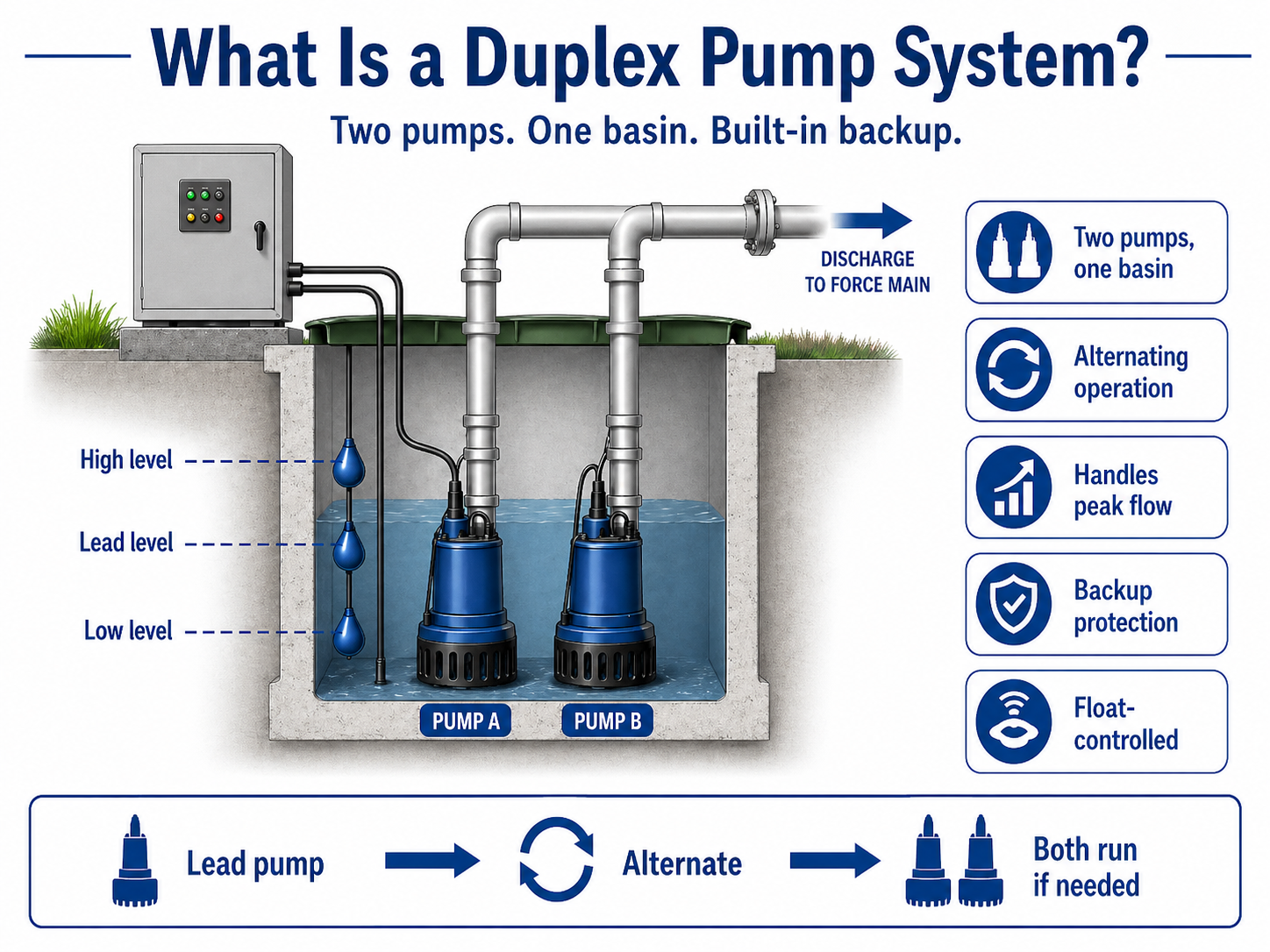
A single pump that fails at the wrong moment — during a peak flow event, a storm, or overnight when no one is monitoring — can cause wet well overflow, regulatory violations, and costly emergency repairs. Understanding what is a duplex pump system is foundational knowledge for anyone designing, specifying, or maintaining a lift station, commercial drainage system, or industrial pumping application where continuous operation is not optional.
A duplex pump system is a pumping configuration that houses two pumps — typically identical in size and type — within a single system, connected to a shared wet well and discharge header through parallel piping. The two pumps are controlled to alternate operation automatically, share the workload during high-demand periods, and provide immediate failover coverage if one unit goes offline. It is the standard configuration for municipal wastewater lift stations across the United States and a common specification for commercial, industrial, and stormwater applications where reliability requirements exceed what a single pump can guarantee.
A Duplex Pump System Uses Two Pumps Configured to Operate Alternately or Simultaneously
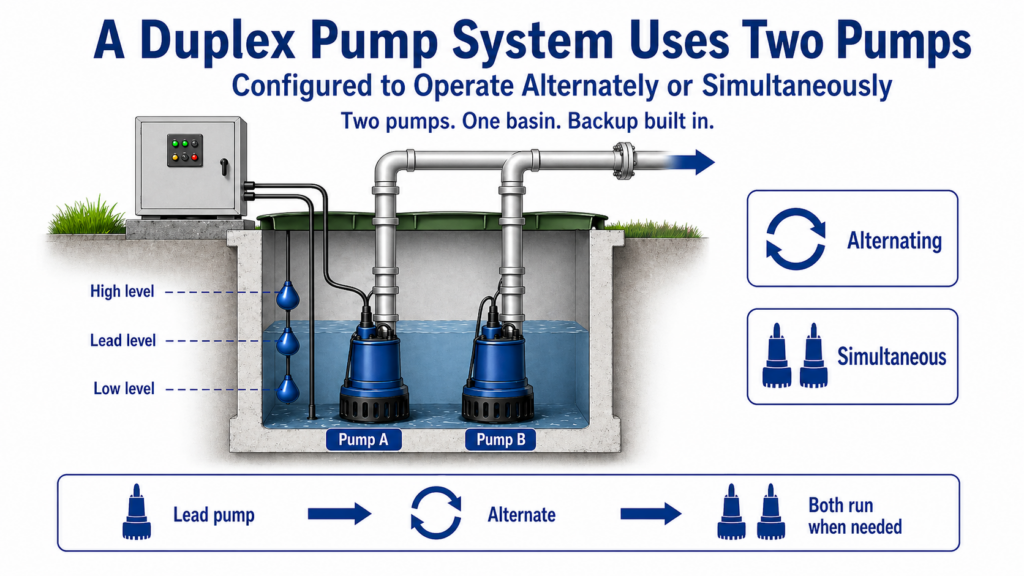
The defining feature of a duplex system is not simply having two pumps — it is how those two pumps are controlled in relation to each other. In a properly configured duplex system, the control panel manages the pumps in a lead/lag arrangement: one pump is designated the lead (primary) unit and starts first whenever the system calls for pumping. The second pump — the lag — holds in standby and activates only under two specific conditions: when the lead pump is running and the wet well level continues to rise above the lag setpoint, indicating the lead pump alone cannot handle the inflow; or when the lead pump fails or is taken offline for maintenance.
The lead and lag designations are not permanent. A properly designed duplex control panel includes an alternating relay that swaps the lead and lag assignments after every pump cycle — so the pump that was lead last time becomes lag next time, and vice versa. This automatic alternation ensures both pumps accumulate equal runtime hours over the life of the system, preventing the common failure mode seen in poorly controlled dual-pump installations where one pump runs constantly while the other sits idle, resulting in one worn-out pump and one that seizes from lack of use.
The piping arrangement in a duplex system connects both pumps to a common suction source (the wet well) and a common discharge header, with individual isolation valves and check valves on each pump’s discharge leg. This allows either pump to be isolated for service without taking the entire system offline — a critical operational requirement for municipal and commercial applications that cannot tolerate planned downtime.
Alternating Lead/Lag Operation Is What Distinguishes a Duplex System from Basic Pump Redundancy
There is an important distinction between a duplex pump system and simply installing two pumps as a primary-and-spare arrangement. A true duplex system with alternating control provides benefits that a static primary/standby configuration does not.
Equal Wear Across Both Units
When pumps alternate the lead role automatically, both units accumulate comparable operating hours over time. This matters for maintenance planning — both pumps approach service intervals on similar schedules, and both are regularly exercised to prevent seal drying, impeller sticking, and motor winding degradation from extended inactivity. In a fixed primary/standby arrangement, the standby pump may sit unused for months or years, often failing at startup precisely when it’s most needed.
Automatic Peak Flow Capacity
When inflow to the wet well exceeds what the lead pump alone can handle, the lag pump starts automatically and both units run simultaneously. This dual-pump operation effectively doubles the system’s pumping capacity during peak events — storm surges, morning demand peaks, or industrial batch discharges — without requiring manual intervention. The system returns to single-pump alternating operation automatically once the wet well level drops below the lag setpoint.
Seamless Failover Without Manual Intervention
If the lead pump trips on a thermal overload, seal failure, or mechanical fault, the control panel detects the condition and starts the lag pump automatically — typically within seconds. Depending on the control system’s configuration, an alarm is simultaneously triggered to notify operators, but wastewater continues moving through the system without interruption. This automatic failover is what makes duplex systems the minimum acceptable standard for most municipal lift stations and any commercial application with overflow consequences.
Where Are Duplex Pump Systems Most Commonly Used?
Duplex configurations appear across a wide range of pumping applications, wherever the cost of system failure — measured in regulatory penalties, property damage, or operational downtime — justifies the investment in built-in redundancy.
Municipal Wastewater Lift Stations
This is the most prevalent application for duplex pump systems in North America. State environmental agencies in most jurisdictions require duplex pump installations as a minimum standard for permitted lift stations — with each pump independently capable of handling the design peak flow. Regulatory guidance from the Great Lakes Upper Mississippi River Board of State and Provincial Public Health and Environmental Managers (Ten States Standards), widely adopted across the Midwest including Indiana, explicitly mandates duplex pump stations for all but the smallest residential applications.
Stormwater and Combined Sewer Pump Stations
Stormwater pump stations face the most dramatic flow variability of any pumping application — flows can increase by an order of magnitude within hours during a major rain event. Duplex configurations are standard for stormwater stations, where the lag pump’s ability to come online automatically during peak inflow is critical to preventing flooding.
Commercial and Industrial Wastewater
Food processing facilities, hospitals, hotels, large commercial developments, and industrial plants with continuous wastewater generation routinely specify duplex pump stations for their internal collection systems. Any facility that operates around the clock or generates wastewater that cannot be safely held in a wet well during an unplanned pump outage is a candidate for a duplex configuration.
Pressure Booster Systems
In high-rise buildings and commercial developments where municipal water pressure is insufficient to serve upper floors, duplex pressure booster systems provide continuous supply pressure with built-in redundancy. Alternating operation ensures consistent pressure delivery while equalizing wear across both booster pumps.
HVAC and Building Services
Chilled water and heating hot water circulation systems in large commercial and institutional buildings commonly use duplex pump configurations to ensure uninterrupted HVAC performance. Loss of circulation in a large building’s HVAC system can affect thousands of occupants — duplex operation eliminates that single point of failure.
The Duplex Control Panel Manages Every Aspect of System Operation
The intelligence of a duplex pump system lives in its control panel. A properly specified duplex control panel does far more than simply turn pumps on and off — it manages sequencing, protection, alarming, and in modern installations, remote monitoring and data logging.
Level Sensing and Control Setpoints
The control panel receives wet well level signals from float switches or, in more sophisticated installations, a continuous level transducer. Discrete float switches are simple and reliable but provide only fixed on/off setpoints. Continuous transducers allow variable-speed pump control via a VFD and more precise wet well level management. Key setpoints include:
- Lead pump on: The level at which the lead pump starts — typically set to maintain a wet well operating range that provides adequate cycle time
- Lag pump on: The level at which the lag pump starts if the lead pump alone isn’t keeping up — set above the lead pump-on level
- Pump off: The level at which running pumps stop — set above the pump inlet to prevent air entrainment and dry running
- High water alarm: Triggers an alarm if the wet well continues rising above the lag pump-on level, indicating both pumps are running but inflow still exceeds capacity — a critical alert requiring immediate operator response
Alternating Relay and Runtime Equalization
The alternating relay is the component that automatically swaps lead and lag assignments after each pump cycle. Most modern duplex panels also include a runtime equalization function that overrides simple alternation if one pump has accumulated significantly more hours than the other — ensuring balance is maintained even during periods of irregular cycling.
Protection and Alarm Functions
A well-specified duplex control panel includes protection and alarming for the full range of failure modes:
- Thermal overload protection for each motor
- Seal failure or moisture intrusion detection (for submersible pumps)
- Phase loss and phase imbalance protection for three-phase installations
- High water alarm with audible and visual indicators
- Pump failure alarm with automatic lag pump start
- Power failure alarm and, where required, automatic dialer or SCADA notification
Remote Monitoring and SCADA Integration
For municipal lift stations and large commercial installations, duplex control panels are increasingly specified with telemetry capability — cellular or Ethernet communication that transmits alarm conditions, runtime data, and wet well levels to a central SCADA system or operator’s mobile device. Remote monitoring allows a single operator to manage dozens of lift stations and respond to alarms without being physically present at each site.
How Does a Duplex System Compare to Simplex and Triplex Configurations?
Duplex is the most common pump system configuration, but it sits in the middle of a spectrum. Understanding when simplex or triplex configurations are more appropriate helps ensure the right system is specified for each application.
- Simplex (single pump): One pump, no built-in redundancy. Appropriate for very small residential applications, temporary installations, or low-consequence systems where a pump failure can be tolerated until repairs are made. Not acceptable for most permitted municipal lift stations or any application with overflow consequences.
- Duplex (two pumps): The standard configuration for municipal lift stations, commercial wastewater, stormwater, and most industrial applications. Provides lead/lag operation, automatic failover, peak flow capacity, and equal wear distribution. Each pump is sized to handle peak flow independently.
- Triplex (three pumps): Three pumps in a rotating lead/lag/standby arrangement. Specified for high-flow applications where two pumps operating simultaneously cannot handle peak demand, for critical installations where N+2 redundancy is required, or for large municipal stations where maintenance windows must be accommodated without reducing pumping capacity below peak requirements.
For most commercial, municipal, and industrial wastewater applications in Indiana and across the Midwest, a duplex configuration is the correct starting point. Deviating toward simplex requires a documented justification, and deviating toward triplex is driven by specific hydraulic or redundancy requirements that a duplex system cannot meet.
Frequently Asked Questions About Duplex Pump Systems
Do both pumps in a duplex system need to be the same size?
In most wastewater and stormwater applications, yes — both pumps are specified as identical units. This is because each pump must be capable of handling peak flow independently when the other is offline for maintenance or repair. Using identical pumps also simplifies spare parts inventory and reduces the risk of control sequencing errors. In some pressure booster or HVAC applications, pumps of different sizes are used intentionally to serve different portions of the load range, but this is the exception rather than the rule for wastewater systems.
How often should a duplex pump system alternate between lead and lag pumps?
Most duplex control panels are configured to alternate the lead assignment after every pump cycle — meaning each time a pump completes a run and the wet well reaches its off setpoint, the other pump becomes lead for the next cycle. This results in both pumps accumulating equal runtime over time. Some panels offer time-based alternation as an alternative, switching lead/lag on a daily or weekly schedule regardless of cycle count. Cycle-based alternation is generally preferred for systems with regular, frequent cycling; time-based alternation is useful for systems with very infrequent pump operation.
What happens in a duplex system when both pumps fail simultaneously?
When both pumps are offline, the wet well continues to fill until it reaches the high water alarm setpoint, triggering an alert to operators. If the system has a high water overflow structure, wastewater may eventually overflow to that point. This scenario — while rare in a well-maintained duplex system — underscores the importance of regular preventive maintenance, alarm monitoring, and for critical stations, remote telemetry that provides immediate notification when the first pump fails so the second failure can be prevented before it occurs.
Can a duplex pump system be retrofitted into an existing simplex lift station?
In many cases, yes. Retrofitting a simplex wet well to duplex operation typically involves adding a second pump, modifying the discharge piping to add a parallel pump leg with check and isolation valves, and replacing the simplex control panel with a duplex alternating panel. The feasibility depends on the size of the existing wet well — it must have sufficient volume and geometry to accommodate a second pump — and the capacity of the existing force main to handle the combined flow of both pumps running simultaneously.
Does Pump Professionals supply duplex pump systems and control panels?
Yes. Pump Professionals supplies duplex pump systems for municipal, commercial, and industrial applications, including submersible pumps from brands like Homa Pumps and Liberty Pumps, as well as duplex control panels and associated equipment. Our team can assist with pump selection, control panel specification, and system design guidance for new installations and retrofit projects. Call (317) 674-3819 or request a quote online to discuss your application.
A Duplex System Is the Baseline for Any Application Where Failure Is Not an Option
The engineering logic behind a duplex pump system is straightforward: wastewater doesn’t stop flowing because a pump goes offline, and the consequences of an uncontrolled overflow — regulatory violations, property damage, public health risk — far outweigh the incremental cost of a second pump and alternating controls. For municipal lift stations, it’s a regulatory requirement. For commercial and industrial applications, it’s standard engineering practice for any system where continuous operation matters.
At Pump Professionals, we work with municipalities, mechanical contractors, plumbers, and builders across Indiana to specify and supply duplex pump systems that are correctly sized, properly controlled, and built around reliable equipment from manufacturers like Homa Pumps and Liberty Pumps. Whether you’re designing a new lift station, upgrading an existing simplex system, or replacing aging equipment in a current duplex installation, our team has the product knowledge and technical experience to help. Call (317) 674-3819 or request a quote online and let us help you build a system that keeps running when it has to.